Reading various comments about belt tension got me thinking about what the actual belt tension of the Core One is. It turns out you can calculate it using easily available numbers and formulas. Many have already done so for other printers, and probably the Core One too, but I wanted to run the numbers myself. I also decided to make some physical measurements to confirm the results.
Since there is usually no easy way to directly measure belt tension, it can be inferred from either deflection or resonant frequency. The Prusa firmware from version 6.4.0 onwards has a tensioning utility that excites the belt and allows you to measure the resonant frequency using the chamber LEDs as a strobe light. It's fast and extremely effective if you use it correctly. I have another page here with more detail on belt tensioning.
To determine the actual tension there is a formula most commonly used for strings, such as found in guitars and pianos, but that is also used for belts. Belts have more damping and air resistance, but the formula still gives reasonably accurate results. It needs the mass per unit length of the belt, the length of the resonant span and the tension, to produce the resonant frequency. Or, it can be rearranged for whichever unknown you desire. In our case, we'll rearrange the formula for tension.
The Prusa belt is a Gates LL-26T E and uses EPDM rubber. I mention the rubber only because EPDM rubber is particularly non-compatible with hydrocarbons and you should be careful not to get any oil or grease on it, nor clean it with hydrocarbon solvents. We need the mass per unit length of the belt. AI will make suggestions around 7.8 grams/meter, but I've found no Gates datasheet for this exact belt. Having little confidence in AI, I bought a couple replacement belts from Prusa and measured them.
The length of the belt coil was 1.525 meters. The mass was 11.05447 grams. That gives the actual mass/length of our Gates belts as 7.249 grams/meter.
To find tension from frequency we use: T = 4·M·W·S^2·f^2·10^-9, where T is tension in newtons, M is mass per length in g/m/mm, W is the belt width in mm, S is the span in mm and F is the resonant frequency in Hz. You can ignore the belt width and just replace M and W with the actual belt mass per meter.
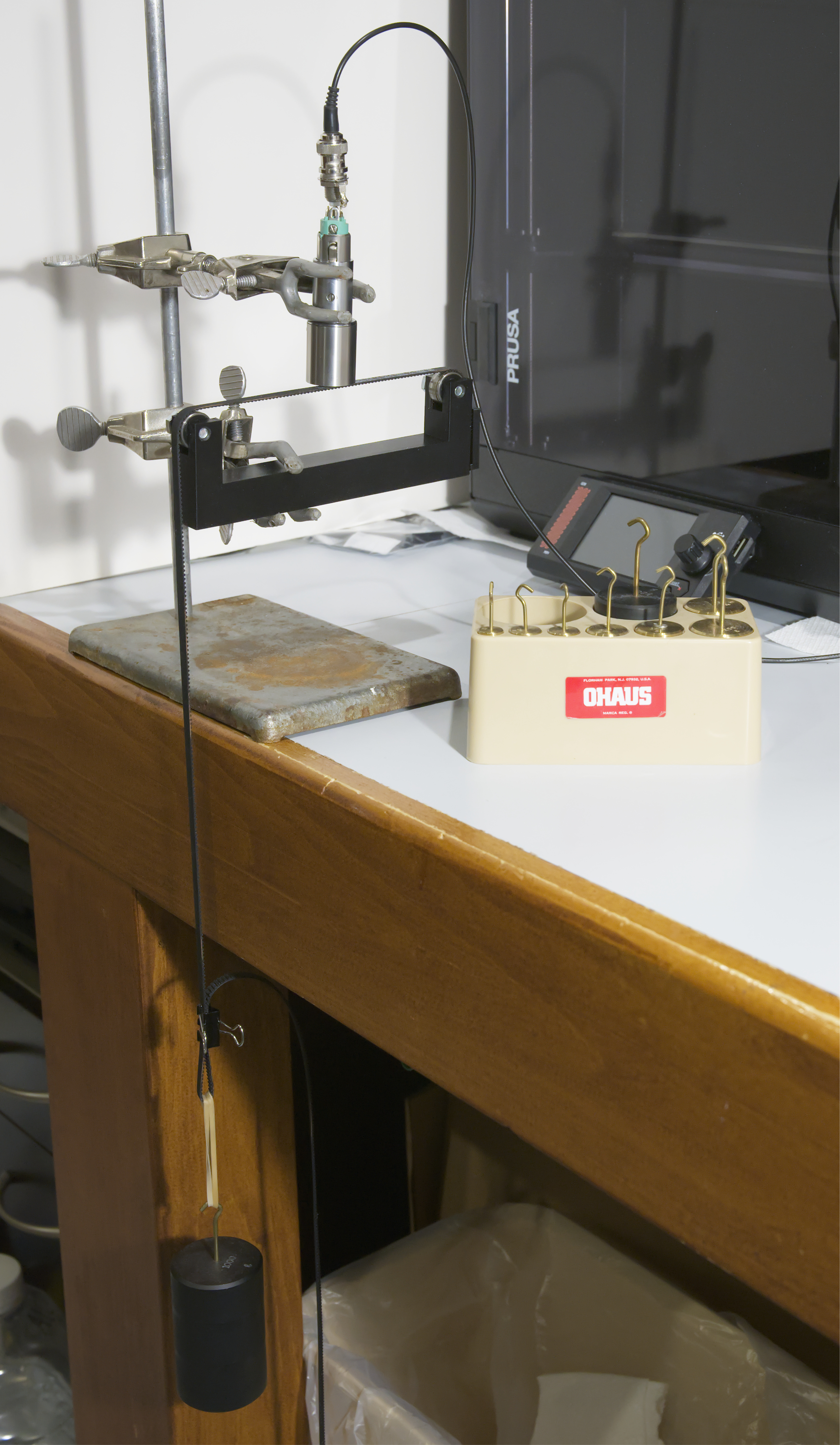
I have little confidence in calculations until they've been proven against physical results. To ease my fears I printed what I call the Fender™ Beltocaster. I don't think it will catch on as a musical instrument as it only plays one note and the belt damping is so high that you don't get any sustain, but it allows measurement for a known belt span. A small microphone was placed above the belt, which was tensioned by weights hung from one end. It's excited by tapping the belt with a small wooden stick. The frequency was measured over ten cycles with my Siglent scope.
I ran three tests with the Beltocaster, 0.5 kg, 1 kg and 1.5 kg. The span of the device is 150 mm and the three frequencies were 89.8, 124.4 and 153.4 Hz.
Plugging the numbers into the formula to solve for tension, and converting from newtons to kilograms, we get 0.536, 1.029 and 1.565 kg. Not exact, but reasonably close. I didn't allow for the weight of the binder clip holding the belt loop (2.84 g) or the extra length of belt hanging below that, maybe 1.5 g, but those are fairly small. Another source of error is more subtle. The belt would only come off the pulleys at the exact 90 degree vertical point if the tension were infinite. At low tensions the belt raises up a bit, making the span longer than the bearing center distance. This probably adds about 2 mm to the span.
I do not know the exact span of the upper belt when the Core One is in belt tension mode, but it's close to 270 mm as measured with a scale from the front. It's a bit vague where the belt is free to vibrate from at the loop under the Nextruder. With some measurements of exactly where the Nextruder is, and if the CAD drawings have enough information, someone more ambitious could probably figure it out with better accuracy. Or, one could remove the Nextruder and get a better physical measurement.
We know the belt tuner sets the maximum frequency of the upper belt at 100 Hz, which would be the maximum tension. Plugging that frequency, the span and the belt mass into the formula, we get 2.15 kg of tension. That seems comfortably within any normal range I've seen published for 6 mm GT2 belts. We're just trying to get a general idea of the tension here so I believe the 270 mm number is good enough for now. One number we do know with high accuracy is the offset of the left side pulleys, 13.5 mm. That will establish the difference between the upper and lower belt frequencies, about 4.7 Hz. The upper and lower tensions should, of course, be identical.
Knowing actual belt tension we can make some educated guesses about various aspects of the COREXY structure, especially the tensioning mechanism.
The first thing to be aware of is that the belt tension appears on both sides of the tensioning pulley, so the force on the pulley/screw is twice the tension, or 4.3 kg. That's 9.5 lbs, slightly less than a glass gallon jug of water.
Tensioning is done by drawing back the belt tensioner using an M3 stainless steel screw, pulling on a small square stainless steel nut. Much has been written about this tensioner, as it's been a source of trouble for many users. The most common problem seems to be seizure of the screw and nut, causing the nut to spin in the plastic body. This isn't surprising as both the screw and nut are stainless steel, a material well known for galling and seizure. Current assembly instructions have you lubricate the screw threads with Prusa grease. This has proven satisfactory in my unit, but a case could be made for a molybdnum disulfide grease that provides more protection against galling. The suitability of an M3 screw for the task has been questioned, but even the lowest grade of M3 screw will have a tensile strength of hundreds of pounds. A rule of thumb says the nut must be at least the diameter of the screw thick for maximum strength. The square nut is 1.72 mm thick and the chamfers make the threaded length even less, so we're probably getting half the strength of the M3 screw. It's still enough, but the high pressures on the thread may be the reason for galling. There's a plastic-safe moly grease made by Tamiya for the R/C folks that might be a better choice.
Similar 10 mm OD 3 mm ID ball bearings as used in the pulleys have a static load rating of about 175 newtons or 17 kg. We have two of them, so 34 kg static load capacity. Dynamic will be far higher, but the printers do spend a lot of time just sitting. I think the safety factor is far more than adequate.
Finally, we have the printed belt tensioner itself. There have been reports of the part splitting at the layers. Prusa may have had a bad run and seems aware of this from field reports. The part is PC-CF, which should be plenty strong unless the layer adhesion is substandard. CF can compromise layer adhesion, but the best choice of material is beyond my expertise. I did print some spares from PETG and they seem extremely strong.
Note that all the above has considered static forces only. The printer has moderate accelerations and actual forces will be higher, though since the parts are accelerated and braked with smallish stepper motors, the forces shouldn't be extreme, and well within safety factors.
C. Hoffman
January 20, 2026
Last edit